
Adapting GLOBE Weather for Students with Disabilities
About the Adapted GLOBE Weather Lessons
Like most science lessons that include hands-on learning, the GLOBE Weather curriculum can often leave students with vision, hearing, or mobility challenges feeling left out.
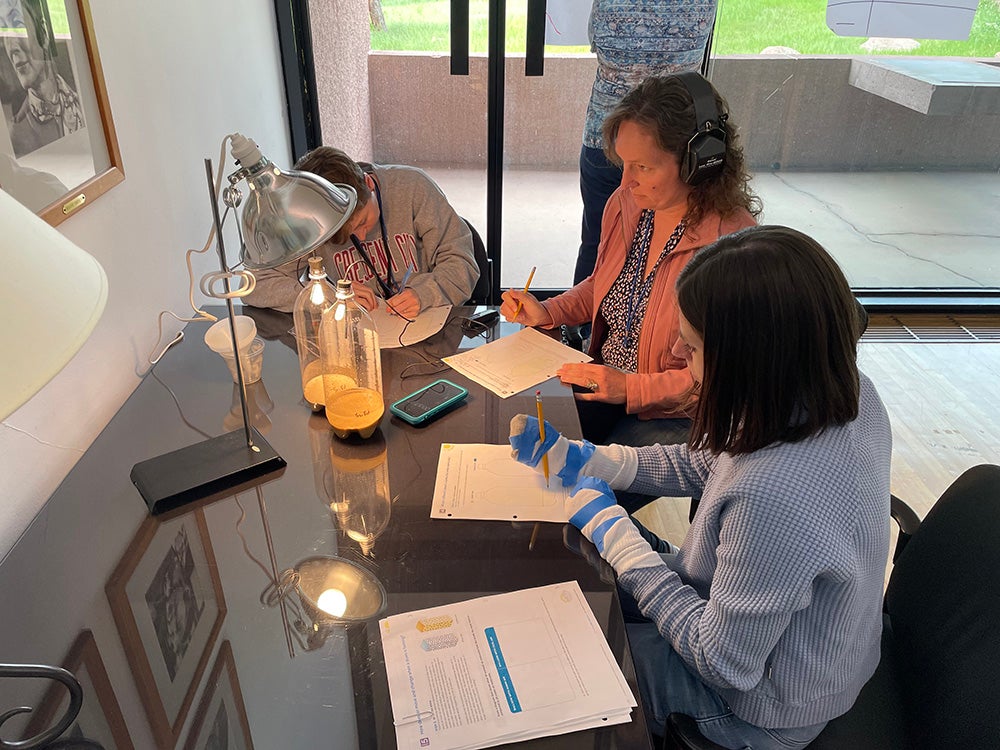
Our cohort of teachers tested materials, learning structures, and instructional approaches based on the Universal Design for Learning (UDL) guidelines to improve access for students with physical disabilities. They used simulators (image, right) to gain first-hand experience of learning with physical disabilities and developed adaptations for specific GLOBE Weather activities during summer workshops over a three-year period.
Note that the GLOBE Weather adapted lessons were developed to specifically support students with physical challenges: visual, hearing, and mobility. Several of the adaptations in this collection also describe benefits for students with different types of developmental or learning disabilities, such as autism, ADHD, and auditory/visual processing disorders. Because UDL principles benefit everyone, the adaptations can also support other unique learning needs.
Many of the adapted GLOBE Weather lessons were designed to meet the needs of a particular focal student and then tested in classrooms. Though the UDL guidelines benefit all learners, they are absolutely crucial for students with disabilities.
What is a focal student?
The focal student is someone who you are struggling to reach or who is less engaged. In this context, our focal students have physical disabilities that might prevent them from fully engaging in our hands-on or collaborative science lessons.
The adaptations and implementation notes provided in the adapted lessons below address the following points:
- What are common characteristics of students who would benefit from adaptations?
- Which parts of the learning activities presented challenges for students with disabilities?
- How can different types of activities be adapted so that my students with disabilities can access them?
These adapted lessons will help educators who are teaching the GLOBE Weather curriculum make the lessons more accessible to students with disabilities, as well as provide a great starting point for educators interested in learning more about integrating UDL into their classroom.
Adapted Lessons:

Tips and Best Practices for Adapting Lessons With Universal Design for Learning (UDL)
General/Overall Best Practices:
- Have one-on-one or small group conversations to learn more about students’ needs and build relationships.
- Try to put yourself in their shoes - walk through each part of a lesson and consider where students with different needs will experience challenges.
- Lean into creativity to support learning - what other types of materials or experiences can you create?
- Present instruction in multiple kinds of modalities - visual, auditory, using tactile models, etc.
- Provide a variety of options for creating student products - use visual and tactile materials, allow students to make recordings instead of writing out responses, etc.
- Include hands-on time for students to explore materials at each stage of the activity.
- Be thoughtful about grouping - for a particular activity, is it best to pair students with similar ability levels or different ability levels?
- Set timers and give warnings when the remaining time is at 2-5 minutes.
- Allow for frequent, short brain breaks.
- Ask “What do you notice?” when looking at graphics, diagrams, lab setups, etc. It’s less intimidating for students to discuss what they notice instead of a more formal “make observations.”
More tips for adapting based on activity type (labs, discussions, group work, etc):
GLOBE Weather Pathways Teacher Cohort
The adapted GLOBE Weather lessons and best practices were developed by the year-three GLOBE Weather Pathways project educators: Christina Belardo, Rachana Bhonsle, Molly Bloom, Stephen Blose, Christina Cortes, Meghan Dragosavac, Katie Flaherty, Stephany Griffin, Kirsten Johnson Nesbitt, Katharine Jones, Marcia Pennock, and Jessica Sanders. Thank you to each of these educators for ensuring that all students have access to science learning.
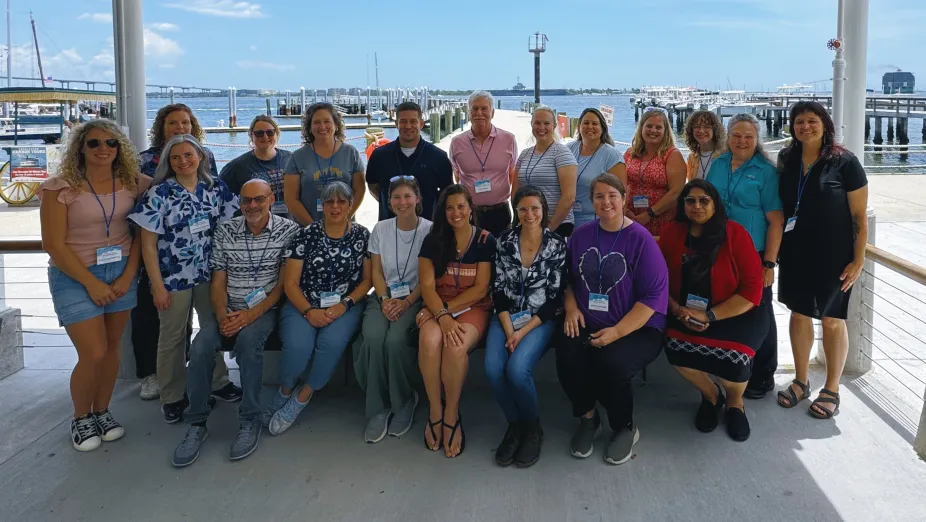
It has truly been a privilege to be part of the Globe Weather Pathways team over the past three years. Working with such passionate and caring professionals to do the work we were able to do together was an unforgettable and deeply meaningful experience. As a blind individual myself, and speaking as a teacher of students who are blind or visually impaired, this cohort helped remind me that there are others all across the field that share the same fire in their belly as I do: to make education - specifically science - accessible and enjoyable for all students, no matter what their limitations.
-GLOBE Weather Pathways Teacher
GLOBE Weather Pathways for Students With Disabilities Project Overview
The GLOBE Weather Pathways for Students with Disabilities developed and tested an approach to provide middle school educators with the experiences, tools, and abilities to adapt geoscience curricula to meet the needs of students with disabilities and to articulate STEM career pathways.
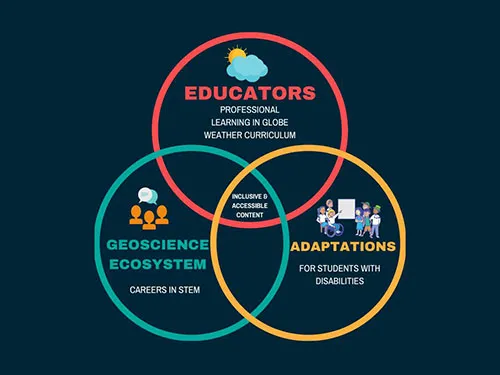
GLOBE Weather Pathways consists of three interrelated components:
- Establish a geoscience learning ecosystem consisting of STEM educators, content specialists, special educators, and STEM professionals with disabilities.
- Professional learning on the GLOBE Weather curriculum.
- Exceptional Needs Workshops where participants adapt materials for middle school students with physical disabilities.
Although many programs have been designed to address increasing enrollment of students with disabilities into science, technology, engineering, and mathematics (STEM) in college (DO-IT, 2006), there has been little or no research on how to support educators directly in K12 classrooms. This project worked to address this gap by creating a learning ecosystem over the course of three years, working directly with STEM professionals to adapt curriculum and focus on career opportunities.
GLOBE Weather Pathways is based on the work supported by the National Science Foundation (NSF) under Grant # 2229351. Any opinions, findings, or conclusions expressed in this material are those of the authors and do not necessarily reflect the views of the National Science Foundation.