Career Profile - Kaylena Pham
Roots in Family and Place: Journey Into Environmental Science
The Spark of Environmental Awareness
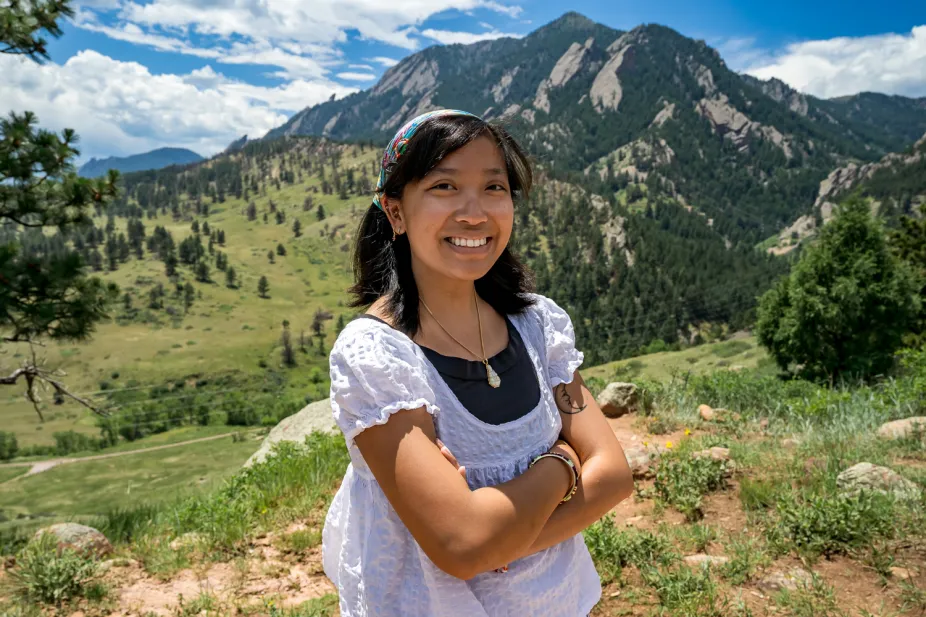
Kaylena in front of the Flatirons outside of the NSF NCAR Mesa Lab.
Kaylena Pham's path into science is deeply rooted in family and place. Growing up, Kaylena’s father shared stories of poor air quality and pollution shaping health and daily life in his small village in Vietnam. That theme resurfaced closer to home: Kaylena's family now lives in an immigrant-dominated community in the U.S., just a few miles from a Superfund site. Watching hardworking immigrant communities impacted by disproportionate environmental burdens, both in Vietnam and in the U.S., planted the seed that would pull them toward environmental science.
Choosing Self-Advocacy over Expectation
When Kaylena arrived at the University of Southern California as a freshman, they enrolled in environmental engineering because it was a conventionally accepted career pathway. "In a lot of immigrant communities, you become a doctor, an engineer, or a lawyer," Kaylena explains. "I thought that was the path I was going to go down as well."
Everything shifted freshman year when Kaylena joined a research lab studying ozone dry deposition on saguaro cacti. They discovered a genuine love for research, spending hours hunkered down on a single question and watching it spiral into ten more. By junior year, Kaylena made the pivotal decision to defy expectations and switch their major to geological sciences, which allowed them to build a research-heavy foundation. Changing majors instilled the value of self-advocacy over fulfilling outside expectations. Taking that step "was not only a challenge, but it really taught me to choose myself," Kaylena reflects.
Connecting Research to Real Lives
That shift eventually led Kaylena to the NSF SOARS program, where their work connected directly to daily human health. Kaylena worked to improve the accuracy of low-cost air quality sensors as part of the 3D PAWS project. The 3D PAWS project provides 3D-printed weather stations to remote locations across the world. Kaylena says they discovered “how these data points and air quality measurements we have through instrumentation truly connect back to the air that people are breathing and living with."
Curiosity, Communication, and No Regrets
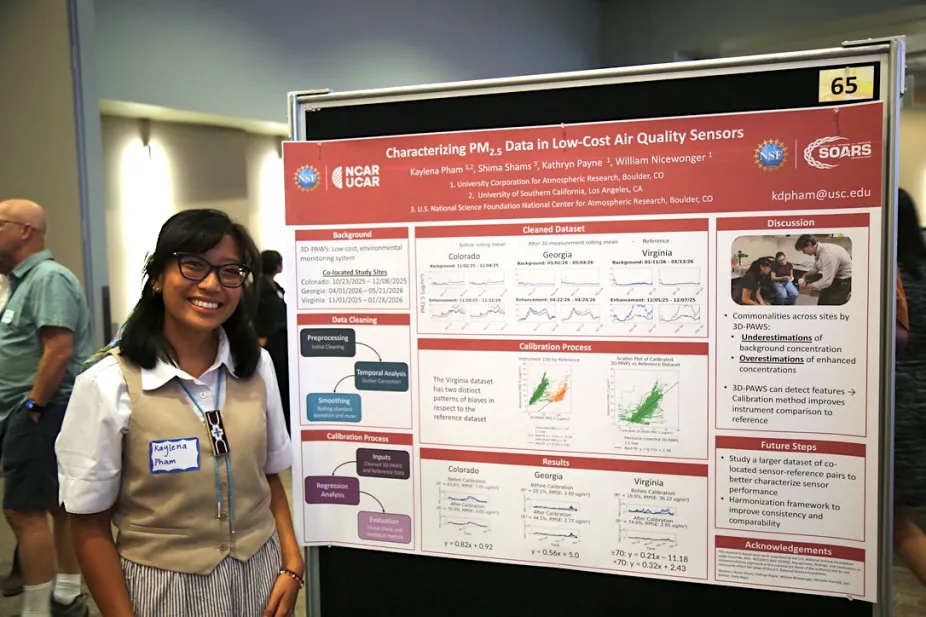
Kaylena in front of their poster at the annual NSF NCAR, UCAR, UCP Summer Student Conference.
Offered as advice to prospective students, Kaylena emphasizes the power of curiosity: ask questions, even if they seem outside your immediate field. "Science itself can be really overwhelming," Kaylena notes. "By asking questions, even to a topic unrelated to your field, you can definitely open a whole new can of worms with perspectives and ideas you might have not thought about before." Kaylena's own trajectory proves this philosophy. Because USC's engineering curriculum did not focus on air quality or atmospheric chemistry, stepping outside their expected realm was the only way they found their true calling.
That same authenticity carries into how Kaylena communicates science. While many peers dread public speaking or writing papers, Kaylena embraces them as natural extensions of a childhood habit. "As a kid, even now, my mom is always like, 'Kaylena, you really like talking a lot,'" Kaylena shares with a smile. Rather than fearing presentations, they view them simply as an opportunity to share their work with others, making even the tedious parts of science feel meaningful.
Looking back, Kaylena reflects on their journey with quiet trust, noting that they would make the exact same choices if they had to do it all over again. In the end, exploring beyond their comfort zone, choosing themselves, and following their curiosity is precisely what brought them where they needed to be.
What's Next
As of 2026, Kaylena plans to finish their senior year at USC. They are preparing for the transition to graduate school. Looking ahead, Kaylena plans to focus on land-to-atmosphere modeling, studying how vegetation and land-use changes like urbanization shape emissions. Because this area of atmospheric research remains understudied, Kaylena aims to help the field better understand how choices made about land today will impact air quality and community health for years to come.