Career Profile - Kara Rydberg
Chasing Understanding: A Path to Meteorology
A Childhood Spent Watching, From a Safe Distance
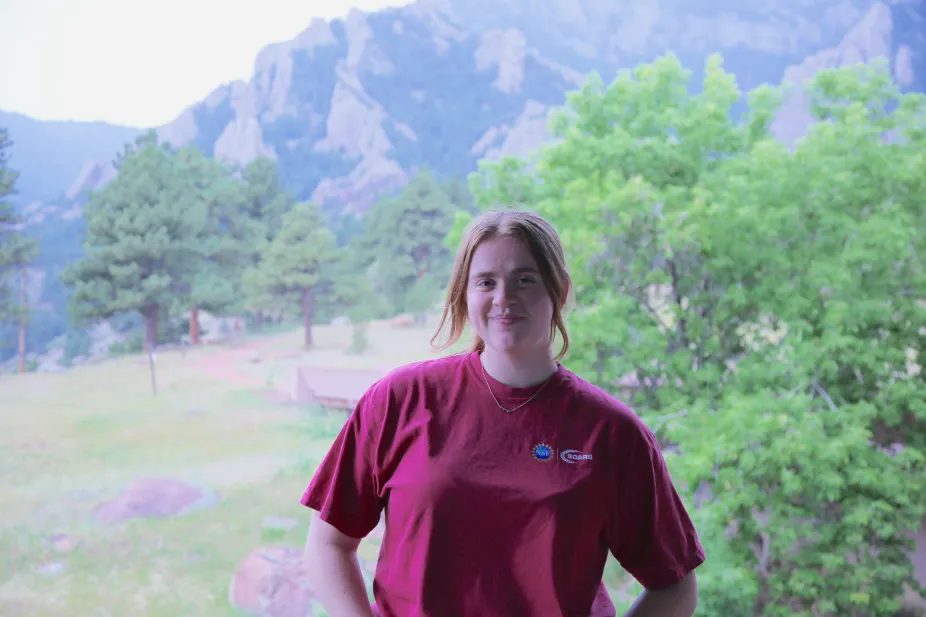
Image of Kara Rydberg in front of the Flatirons at the NSF NCAR Mesa Lab.
Growing up in Chicago, Kara Rydberg was afraid of the weather. "I actually hated it," she recalls of her early relationship with storms. Yet, there was an intriguing twist to that fear. As a child, she loved curling up with her tablet to watch live storm coverage on The Weather Channel - provided the severe events were happening somewhere else.
One memory stands out clearly from 2013, watching the Moore tornado unfold live from her living room and tracking history in real time. Understanding a storm's power without having to live through the immediate danger of its impact became a thread that stayed with her. Even today, she regularly checks radar for fun, drawn to the mechanics of severe weather while remaining clear-eyed about the destruction it causes.
The Move to Florida, and the Storm That Changed Everything
When her family relocated to Florida, Kara’s childhood fear turned into genuine interest. Her high school environmental science teacher tipped the scales early on by reassuring her that real careers existed in atmospheric science. "Sometimes you just need that person to spark it in you," Kara reflects, "because it's fun - but it's hard, [and] you need someone to tell you it's fun because it's hard."
That perspective continued during her first year of college when Hurricane Ian tore through her hometown. Confident in forecast models showing the storm curving away, Kara initially stayed put in Tampa, then evacuated 90 miles south, only for the storm to shift once more. Ian’s eye made landfall just seven miles from her house. For eight hours inside the eyewall, Kara and her family lost power and watched their roof get torn apart. Experiencing the unpredictability of forecasting firsthand gave her a clear mission. "I can possibly do something to help this for the future," she said. She transferred from University of South Florida to a newly launched meteorology major at the University of Florida, becoming one of its first graduates.
Overcoming the Odds and Proving Herself Wrong
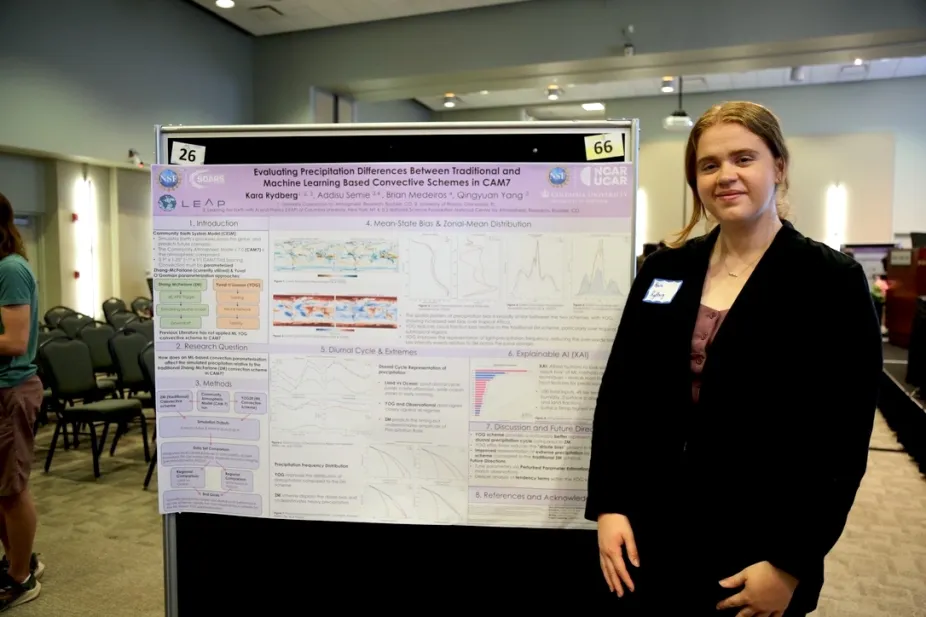
Image of Kara Rydberg in front of her NSF SOARS poster at the NSF NCAR, UCAR, UCP Summer Student Conference.
As a first-generation college student, she leaned on pure self-reliance to navigate university life. Financially, she worked late-night closing shifts past midnight right before morning exams, watching classmates dedicate weeks to studying that her schedule didn't allow for herself. Her biggest single hurdle came during her sophomore year when she was diagnosed with an autoimmune disease, leading to a hospitalization, dropping classes, and receiving monthly infusions alongside a demanding course load.
Perhaps the most personal trial involved overcoming labels. Growing up alongside a twin sister cast as "the science one," Kara had internalized an assumption that she simply was not good at math or science. She challenged that belief when she excelled at general chemistry, a weed-out class with a 60% fail rate. Realizing mid-semester that no one had declared her a failure, Kara studied daily between classes, learning the material while managing her new health diagnosis. Passing proved to be a defining turning point, shattering her self-doubt.
Why the Science Matters
Today, Kara’s research centers on extreme weather impacts, focusing on process-level dynamics behind severe thunderstorms, convection, and freezing rain. Her recent work involved estimating convection within earth system models to improve how precipitation is represented in long-term climate simulations, alongside exploring machine-learning methods.
For Kara, technical research always connects back to a human purpose: better forecasting. High-quality models give emergency managers critical lead time, allowing communities to evacuate rather than scramble, a motivation rooted directly in the eight hours she spent in Hurricane Ian's eyewall.
Advice for the Next Generation
Drawing from her own journey, Kara offers honest wisdom for prospective students. She encourages them to embrace the difficulty of STEM coursework, emphasizing that pushing through hard challenges is what makes it rewarding. Rather than getting discouraged by a rough exam, she stresses allowing your goals to evolve naturally and keeping note of your overall goal. Her own path shifted from broadcast meteorology to operations before finally landing on research, proving her connection to science is defined by a commitment to understanding rather than obtaining an initial job title. She urges students not to fear taking leaps, because calculated risks often lead to where you truly thrive. Most importantly, Kara views rejection simply as redirection. Missing out on her original dream school led her to a close-knit program where she could access tailored mentorship and build her foundation as a researcher.
What's Next
Looking ahead, Kara plans to begin graduate school in spring 2027, with aspirations to earn her PhD. Her goal is to pursue a research career in academia or in an institution like NSF NCAR, driven by a simple love of bringing clarity to complex natural systems. Her relationship with weather has come full circle: transforming from a frightened kid watching storms from a safe distance into a dedicated scientist working to make sure fewer communities face severe weather unprepared.