
Main navigation

UCAR Logo
Center for Science Education
Contact Us
  • Home
  • About
    • Collaborate with Us
    • Affiliations and Partnerships
    • Supporters
    • UCAR Center for Science Education Logo
  • Educators
    • Teaching Resources
    • School Field Trips to NSF NCAR
    • Join Us Virtually
    • Teacher Professional Development
  • Explore
    • Learning Zone
    • SkySci for Kids
    • Explore Virtually
    • Careers in STEM
    • STEM at Home
  • Visit
    • Visit NSF NCAR
    • Join Us Virtually
    • Exhibits
    • Visitor Accessibility
  • Events
  • Support Our Mission
Contact Us

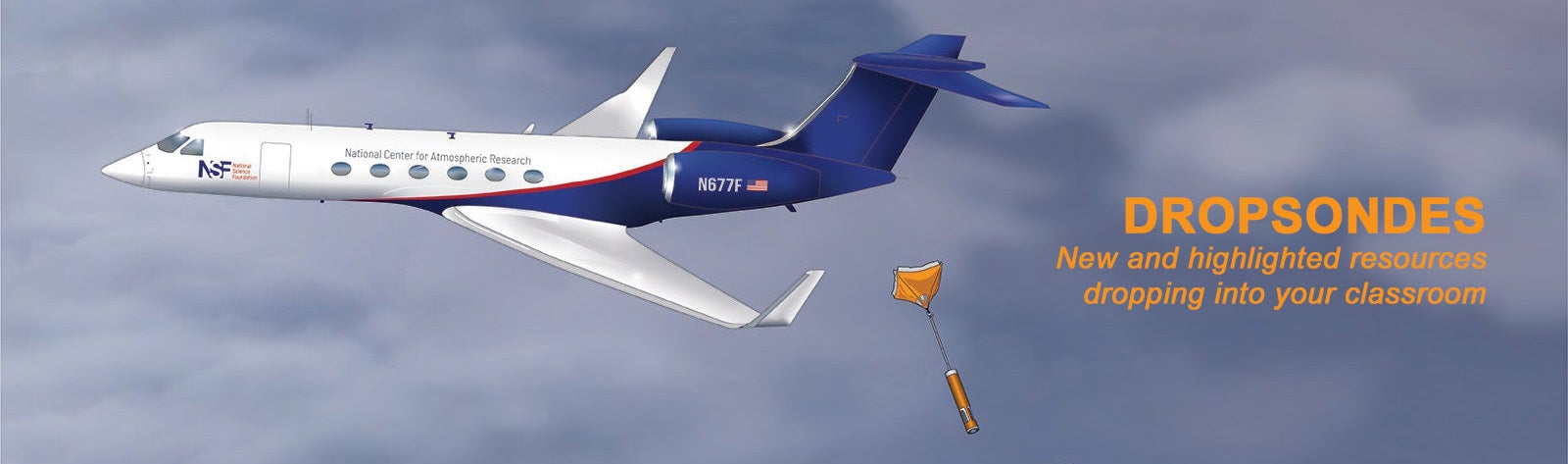
Dropsondes.  New and highlighted resources dropping into your classroom
What is a dropsonde?

New on the Learning Zone

  • A Super El Niño Is Very Strong, But Even Weaker El Niños Affect the Weather

    Scientists categorize El Niños as weak, moderate, strong, or very strong. With data from buoys and satellites, computer models forecast whether El Niño is likely in the coming months. 
  • Is It the Heat, Humidity, or Both?

    The combination of high humidity and high temperatures can lead to extreme heat and dangerous conditions.
  • Fast Fires: A Compelling Way to Understand Wildfires

    Fast fires are becoming more common. Studying fire speed can aid in managing and preventing fires.
  • Using Models to Predict Wildfire Risk

    Researchers at NSF NCAR use models to help predict and understand wildfire behavior.

New Games & Interactives

  • Ozone Story

    Click around in this interactive story to discover how ground-level ozone pollution forms.

New Classroom Activities

  • Pika Data Detectives: Evaluating AI Science Claims

    Students analyze an AI-generated interpretation of data about pika behavior in the alpine tundra to understand the impact of temperature on pikas as an indicator species.
Upcoming Professional Development

  • What is El Niño and How Might It Affect Our Weather This Year?

    Join us for a free webinar to learn how scientists monitor and predict El Niño events.

NSF NCAR

  • NSF NCAR Homepage
  • ACOM | Atmospheric Chemistry Observations & Modeling
  • CGD Laboratory
  • CISL | Computational & Information Systems
  • EdEC | Education, Engagement & Early-Career Development
  • EOL | Earth Observing Laboratory
  • HAO | High Altitude Observatory
  • MMM | Mesoscale & Microscale Meteorology
  • RAL | Research Applications Laboratory

UCAR

  • UCAR Homepage
  • Community Programs
  • Education & Training
  • For Staff
  • Government Relations & External Engagement
  • Member Institutions
  • Tech Transfer & Engagement
  • University Collaboration

Subscribe to Monthly K-12 News


Learn more about our monthly newsletters

Follow Us on Social Media!

© 2026 UCAR

  • Privacy
  • Cookies
  • Web Accessibility
  • Terms of Use
  • Copyright Issues
  • Sponsored by U.S. NSF
  • Report Ethics Concern
  • Staff Login
Postal Address: P.O. Box 3000, Boulder, CO 80307-3000 • Shipping Address: 3090 Center Green Drive, Boulder, CO 80301
NSF Logo

This material is based upon work supported by the NSF National Center for Atmospheric Research, a major facility sponsored by the U.S. National Science Foundation and managed by the University Corporation for Atmospheric Research. Any opinions, findings and conclusions or recommendations expressed in this material do not necessarily reflect the views of the U.S. National Science Foundation.