The Beaches Are Shrinking! How Coastal Squeeze Causes Beach Erosion
Key Takeaways
Beaches move landward as sea level rises and storms grow stronger, but along developed coasts they often do not have space to move, so instead they erode away, a phenomenon called coastal squeeze.
Adding sand can help restore eroded beaches, but it is expensive, temporary, and can disrupt wildlife. Restoring sand dunes can give beaches a source of sand that persists.
Some communities opt to move buildings and other structures away from coasts to prevent coastal squeeze as well as flooded roads and buildings.
Beaches made of sand can change shape over time as the grains of sand move in the wind and waves. They may shrink during storms as sand erodes away, and then grow larger as calmer waves bring new sand to the beach.
But around the world, many beaches have been eroding for years or decades without growing again. About one-third of the world’s coasts have sandy beaches, but 20% to 24% of those beaches are eroding rapidly, according to scientists who studied coasts with satellite images to explore how beaches worldwide have changed. It’s likely that even more beaches will erode as sea level rise speeds up this century, although, as we will see, sea level rise is not the only reason that beaches are shrinking.
Beaches have important roles as coastal protection during storms and habitat for wildlife like shorebirds, crabs, clams, and sea turtles that lay eggs in sand. People, of course, also flock to beaches for fun. Shrinking beaches affect the lives of people in coastal cities and towns and wildlife that needs beaches.
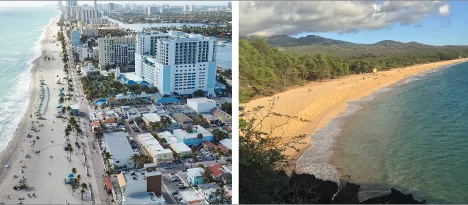
Beaches along developed coasts, like Miami Beach on the left, are more likely to be affected by coastal squeeze than beaches on undeveloped coasts, like the Maui, Hawai’i, beach on the right.
Credit: Carol M Highsmith (left), Jason Tester (right)
Along a coast without roads or buildings (which is called an undeveloped coast), a beach will typically move landward over many years as sea level rises. Its sand will also be tossed landward by waves from storms like hurricanes, which are growing stronger as the climate warms and changes.
But along a developed coast with cities, towns, roads, and other human-built infrastructure, a beach can’t move landward as it is pummeled by waves and as sea level rises. Instead, the sand erodes away and the beach shrinks. This phenomenon is called coastal squeeze because the beach is squeezed between communities and the ocean.
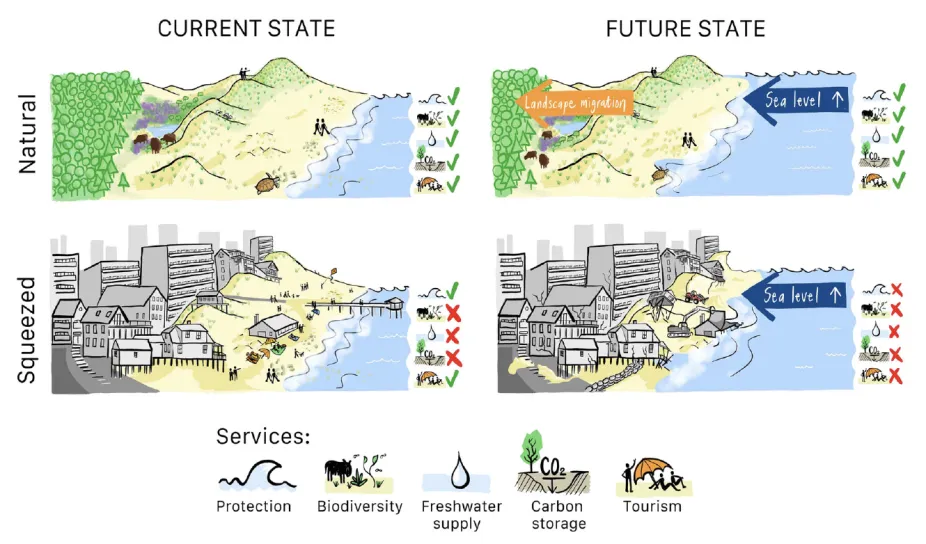
Natural (or undeveloped) sandy coasts can move landward in the future as sea level rises, while beaches along developed coasts are vulnerable and likely to be squeezed. Figure from Lansu et al. (2024), A global analysis of how human infrastructure squeezes sandy coasts, Nature Communications
Credit: Lansu et al.
Along coasts lined with long, narrow barrier islands made of sand (like most of the U.S. East Coast) sea level rise and strengthening storms also cause coastal squeeze, although sometimes it’s not the beaches that shrink. When undeveloped barrier islands move landward, they take space from the calm water lagoons and salt marshes between islands and the mainland. This causes lagoons and marshes to shrink. A developed barrier island with cities and towns, unable to move landward, is prone to erode and may disappear entirely over time.
Beaches also shrink along coasts with seawalls. These human-made walls of rock or concrete are built to protect cities and towns from flooding and waves, but seawalls also typically destroy the beaches next to them. As waves crash on a seawall, their energy scours sand away from the beach, sending it out to sea; it eventually settles down on the ocean floor. For example, a seawall was built in 1900 on Galveston Island, a barrier island on the Texas coast, to protect the city during hurricanes. The beach next to the seawall eroded away in about two decades. That was before beaches were shrinking as the impacts of warming climate were causing coastal squeeze. Today the combination of seawalls, sea level rise, and strengthening storms is even more of a threat to beaches.
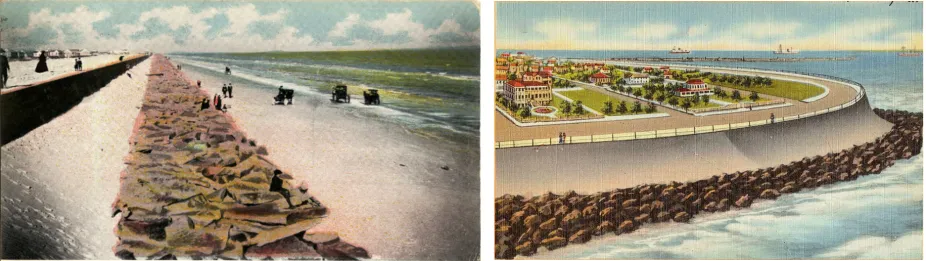
The postcard on the left shows what the seawall and beach looked like in Galveston, Texas, in 1907, seven years after the seawall was constructed. The postcard on the right, shows Galveston and its seawall between 1930 and 1945, after the beach eroded.
Credit: Public domain images from the University of Houston Digital Library (left) and Boston Public Library (right)
What can we do to save beaches?
To reverse erosion, huge amounts of sand are added to beaches, a process called beach nourishment or sand replenishment. The sand is often pumped up from the seafloor in a giant hose and then spread by bulldozers. Beach nourishment can rebuild a beach — the Galveston beach that eroded along a seawall was later recreated this way — but it is expensive and temporary. Erosion continues, so sand that is added will eventually be gone. In addition, moving massive amounts of sand can disrupt wildlife, both on the beach where sand is added and on the seafloor where sand is removed.
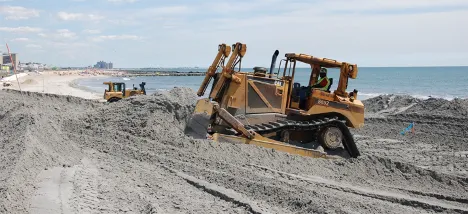
After Rockaway Beach in Queens, New York, eroded during Hurricane Sandy, more than 3.5 million cubic yards of sand was pumped from the seafloor to the beach and then smoothed out by bulldozers in 2013.
U.S. Army
Dunes are a natural source of sand for beaches and help protect coastal communities, but they are often destroyed when buildings and roads are built. Sand dunes can be restored, often by adding native grasses and other plants at the landward edge of a beach. The plants’ roots hold sand in place, and more sand, carried by wind and waves, naturally collects around the plants.
Because undeveloped coasts are not as affected by coastal squeeze, coastal nature preserves can help protect beaches. Another way to let beaches move instead of eroding is to design buildings that allow sands to shift. And if buildings near beaches are needed, designing structures that allow sands to shift over time, and that are movable, can help keep beaches from shrinking. Developed coasts can avoid coastal squeeze by moving buildings, roads, and other structures away from the shore, which is called managed retreat. When people in a coastal community disagree about what needs to be done, it can be challenging to make a plan for managed retreat. But a plan can have big benefits: saving beaches and protecting homes and roads from flooding and other damage. In the city of Ventura, California, roads, a bike path, and parking lots were moved away from the coast at Surfers Point, where the beach had been eroding for decades. Areas on Surfers Point that used to be paved are now part of the beach and sand dunes.
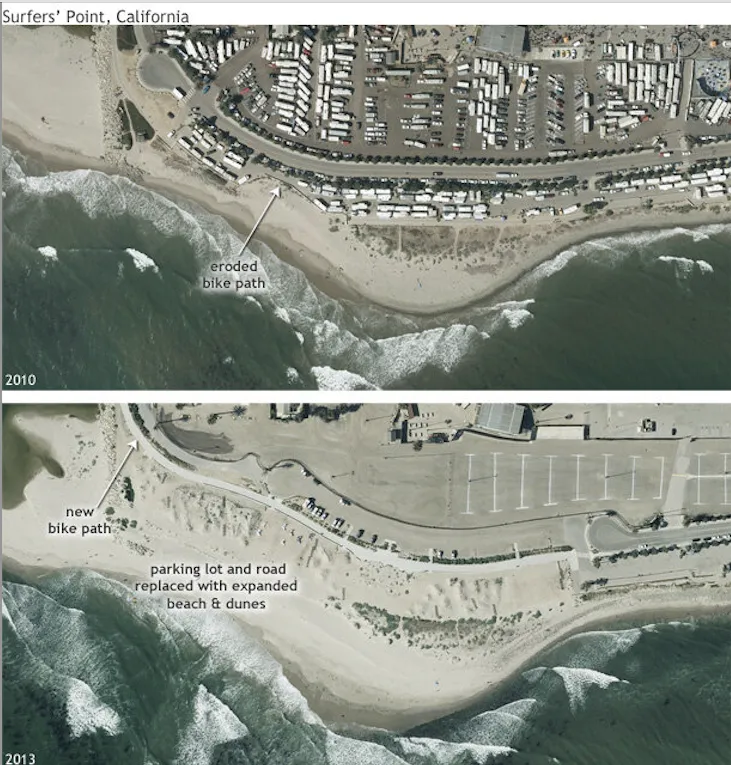
In 2010, the beach at Surfers Point in Ventura, California, and its coastal bike path were eroding away and the fairgrounds’ parking would erode next (top). With managed retreat, the city of Ventura moved the bike path, parking, and road landward and restored the beaches and sand dunes.
According to recent modeling, half the world’s beaches could be lost by the end of the century. But the number of beaches that are actually lost depends on our actions. People who live near coasts can take action by moving structures, including seawalls, from beaches and by restoring beach sand and dunes. And all of us can help beaches, even if we don’t live near one, by releasing less heat- trapping greenhouse gases into the atmosphere to slow warming and sea level rise.